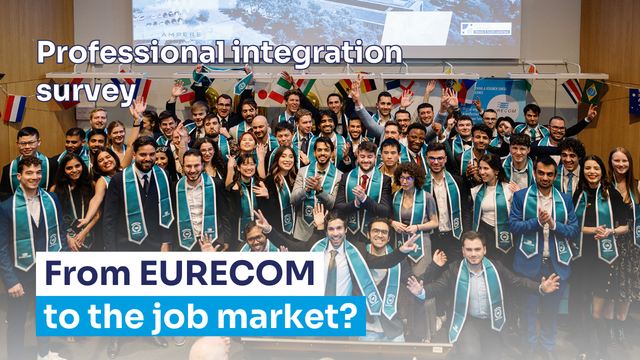
For future graduates in digital technologies, understanding career prospects after graduation is essential. This survey provides a concrete picture of what EURECOM graduates do after completing their studies and how quickly they integrate into the job market.
Survey methodology
This survey was conducted in May 2025 among 286 EURECOM graduates: 177 from the 2023 class and 109 from the 2024 class. Through 53 structured questions, we collected detailed information about the respondents' profiles, their training path at EURECOM, and any additional training they pursued after graduation. Graduates also shared their professional situation one year after graduation and at the time of the survey.
Training aligned with professional aspirations and market needs
The results demonstrate excellent alignment between our graduates' career paths and their initial aspirations: more than 8 out of 10 graduates report satisfaction with this match. Notably, 44% hold positions involving responsibilities similar to those of a research engineer.
Graduates emphasize that their intellectual curiosity, appetite for continuous learning, and methodological rigor are major assets in achieving their professional goals. They believe they have developed the necessary skills to meet job market requirements. This perception is reflected in their satisfaction rate with their EURECOM training, which reaches 82% this year.
High-value expertise areas
Analysis of employment sectors shows a strong presence of graduates in cybersecurity, which accounts for 42% of current positions. Digital technology and innovation consulting also represent a significant share of professional outcomes, at 22%.
Other employment outcomes for the 2023 and 2024 graduating classes include next-generation networks, academic research, and software development.
Learn more about the data collected in the survey
Rapid professional integration and attractive compensation
The training provided at EURECOM promotes rapid and sustainable professional integration. The majority of our graduates find employment within 3 months of graduation. In parallel, 20% choose to continue their academic path, particularly through MS/MSc programs or doctoral studies.
While more than half of graduates work in France (54%), a significant proportion (46%) build their careers internationally. The private sector remains the main employer, representing 90% of professional opportunities.
Our graduates' preferred employment selection criteria are, in order of importance: alignment between the position and their professional project, the sector of activity, and compensation level (determining factors for 68% of them). In their first job, gross annual compensation is predominantly between €40,000 and €49,000, with an average salary of €50,000 (excluding bonuses and premiums).
Remarkable professional integration indicators
Twelve months after graduation, 90% of our graduates are professionally active, either full-time or part-time. The figures demonstrate a particularly dynamic market for our profiles: 79% find employment within 3 months of graduation. At the time of the survey, nearly 9 out of 10 respondents are professionally active, with 7 out of 10 on permanent contracts.
Professional experience plays a decisive role in accessing employment. Thus, 36.7% of our graduates obtain their first position through internships completed during their training.
These results illustrate the relevance of EURECOM's pedagogical model, which combines academic excellence with practical application of the teachings provided. The alignment between our training programs and labor market needs, combined with the aspirations of our digital engineering students, translates into successful professional integration and promising career paths.
In line with our commitment to continuous improvement and tracking graduates’ career paths, the Class of 2025 will soon be invited to participate in the next professional integration survey. Graduates will shortly receive all the information needed to contribute to updating these key indicators.